
The estimate is in hand, and the next question is how to pay for it. Most people looking for remodel financing in Connecticut are weighing the same handful of options, and the right one depends on the size of the project, how fast you need the money, and whether you want to put your house up as collateral.
Myers Home Improvements is a remodeling contractor, not a lender or a financial adviser, and none of this is financial advice. What follows is how each option actually works, which projects it tends to fit, and the questions we hear most often at the kitchen table when the numbers come out.
The options at a glance
| Option | Best for | Secured by your home? | Speed | Watch for |
|---|---|---|---|---|
| Savings, in phases | Refreshes, single rooms, and anyone who wants no debt | No | Immediate | Phasing a big project usually costs more overall |
| Contractor-arranged financing | Most kitchens, bathrooms, and basements, $500 to $200,000 | Typically no | Fast | Rates and terms depend on the lender and your credit |
| HELOC | Larger or multi-phase projects | Yes | Weeks | Variable rate, and a line is easy to overspend |
| Home equity loan | One large project with a firm estimate | Yes | Weeks | Closing costs; fixed payment |
| Personal loan | Smaller projects, or owners with little equity yet | No | Fast | Higher rates than secured options |
| Smart-E Loan (CT Green Bank) | Energy and resiliency work up to $50,000 | No | Weeks | Only 25% of the loan can go to non-energy work |
| Renovation mortgage (FHA 203(k) and similar) | Buying or refinancing a house that needs work | Yes | Slowest | Paperwork, draw schedules, lender approval of the contractor |
1. Savings, and paying in phases
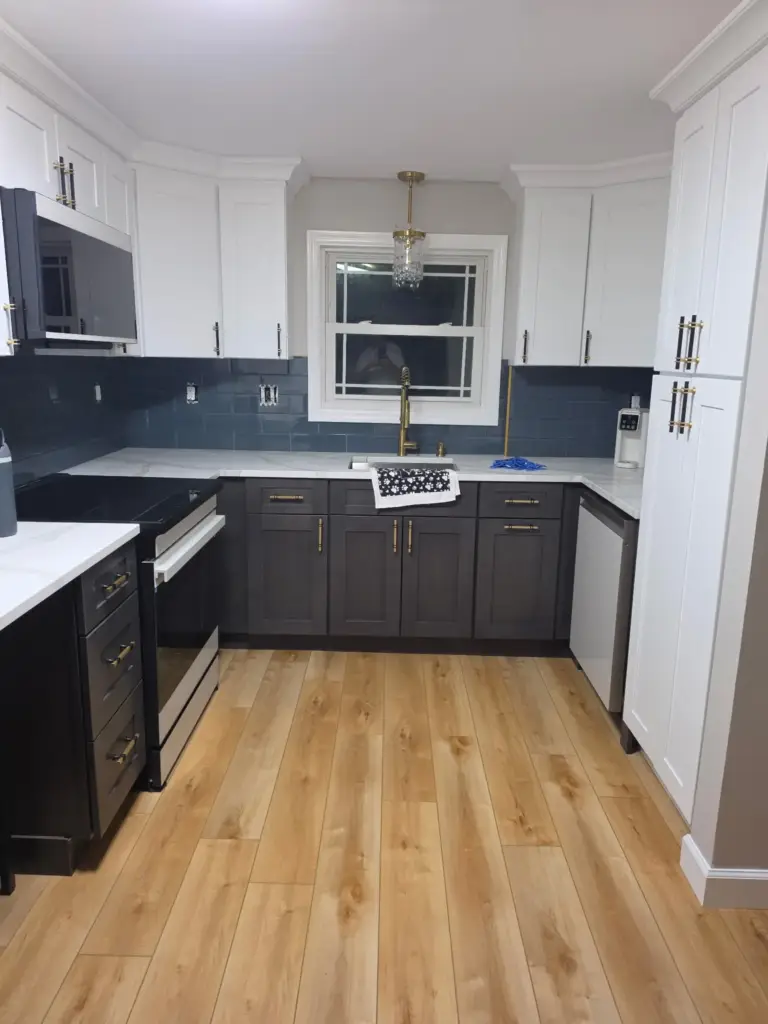
Paying cash is the cheapest money there is, and for a bathroom refresh, a floor, or a ceiling job it is how most people do it. For a larger project the question becomes whether to wait and do it all at once or break it into phases. Phasing works when the pieces are genuinely separable. Our Wethersfield kitchen is a good example: new granite counters and a subway tile backsplash on the existing oak cabinets, a focused project that stands on its own. Phasing works less well when the phases overlap physically. A kitchen floor installed this year gets cut around cabinets that move next year, and two mobilizations cost more than one.

However you pay, do not pay for the whole job before it starts. Connecticut requires a home improvement contract to be in writing, with a start date and a completion date, and the payment schedule belongs in that document. We cover what the contract has to contain in how to check a Connecticut contractor before you sign.
2. Contractor-arranged financing
When people ask whether contractors offer payment plans, this is usually what they mean. The contractor is not the lender. A partner lender funds the project, you repay the lender in fixed monthly payments, and the contractor is paid on the schedule in your contract. Myers Home Improvements works with a financing partner that offers options from $500 to $200,000. Checking your options uses a soft credit pull, so it does not affect your score, and it works for any project we do, from a bathroom to a full basement finish. You can check before or after the estimate, and you are never required to use it.
Two things to read carefully in any contractor-arranged offer, ours included. First, the rate and term, which depend on the lender and your credit rather than on the contractor. Second, any promotional interest-free period. Deferred-interest offers are common in the industry, and some of them charge all the interest retroactively if the balance is not cleared by the end of the promotional window. Ask how it works before you sign. Full details of our program are on the financing page.
3. Home equity line of credit (HELOC)
A HELOC is a revolving line secured by your house. You draw what you need during a draw period, pay interest on what you have drawn, and repay the balance later. The rate is usually variable. It suits projects that unfold over time or a whole-house plan with several rooms, because you borrow as invoices come due rather than all at once. The risks are the ones you would expect: the rate can rise, the house is the collateral, and an open line makes scope creep painless right up until the statement arrives.
One tax note. Under current federal rules, interest on a home equity loan or line is deductible only when the money is used to buy, build, or substantially improve the home that secures it, and only within the overall mortgage debt limit, which the IRS sets at $750,000 for most filers. A kitchen or bathroom remodel generally qualifies as a substantial improvement; paying off a credit card with the same line does not. Confirm your own situation with a tax professional.
4. Home equity loan
A home equity loan is a lump sum secured by the house, usually at a fixed rate with a fixed payment. It fits one large, well-defined project with a firm written estimate, such as a full kitchen or a basement finish with a bathroom, where you know the number and want it locked in. Expect closing costs and a few weeks to fund. The same tax rule as a HELOC applies.
5. Personal loan
An unsecured personal loan from a bank, credit union, or online lender funds quickly and does not touch your house. Rates are higher than secured options because there is no collateral, and amounts are usually smaller. It makes sense for a bathroom refresh, new flooring across a floor of the house, or ceiling and paint work, and for recent buyers in towns like Bristol, Plainville, or New Britain who have not built enough equity for a HELOC yet.
6. Smart-E Loan from the Connecticut Green Bank
This is the Connecticut-specific option most people have never heard of. Smart-E is a state-sponsored unsecured loan program run by the Connecticut Green Bank through participating local lenders. As listed on the Green Bank’s site in September 2026, loans run up to $50,000 with terms of 5, 7, 10, 12, or 15 years, at published APRs of 6.99% for the 5, 7, and 10 year terms, 7.49% for 12 years, and 7.99% for 15 years. The rate does not vary with your credit score, although qualification does consider credit and debt-to-income ratio. The home has to be an owner-occupied building of one to four units in Connecticut.
The catch is what it covers. Smart-E is for energy and resiliency improvements, and the program lists more than 90 eligible measures, including insulation, windows, heat pumps, water heaters, plumbing, and roofs. Up to 25% of the loan can go to non-energy work. In practice that means Smart-E can fund the windows and doors in a project, insulation added while walls are open, and a quarter of the rest, but it will not carry a whole kitchen on its own. Rates and terms change, so check the current figures on the Green Bank site before planning around them.
7. Renovation mortgages: FHA 203(k) and similar programs
If you are buying a house that needs work, or refinancing one, a renovation mortgage rolls the cost of the work into the loan. The best known is the FHA 203(k), which comes in two versions. The Limited 203(k) covers up to $75,000 in repairs since HUD raised the cap in November 2024, and no FHA consultant is required. The Standard 203(k) handles larger or structural work and requires an FHA-approved 203(k) consultant. Fannie Mae’s HomeStyle Renovation loan is the conventional equivalent. These are the slowest option here, the lender approves the contractor and pays in draws against inspections, and the contractor has to be willing to work inside that process. If you are going this route, tell your contractor at the first walkthrough, not at the signing.
Matching the option to the project
The tiers below are rough, and the bathroom figures in our Connecticut bathroom cost guide show how much a single room can vary. But as a starting frame:
- Under about $15,000, such as a bathroom refresh, new flooring, popcorn ceiling removal, or painting a floor of the house: savings, contractor-arranged financing, or a personal loan.
- $15,000 to $50,000, such as a full bathroom remodel, a basement finish, or a kitchen that keeps its layout: contractor-arranged financing, a HELOC or home equity loan, and Smart-E for any energy portion.
- $50,000 and up, such as a kitchen with layout changes, an in-law suite in the basement, or a whole-floor rebuild after water damage: home equity, a cash-out refinance, a larger contractor-financing approval, or a renovation mortgage if you are buying.
Get the estimate first, then the financing
The order matters. Financing a guess means either borrowing too much or coming up short halfway through the job. The sequence that works:
- Get a written scope and estimate after a walkthrough, not a phone call. Every option above is easier to compare with a real number.
- Add a contingency. On a house built before 1970 we suggest holding back 10 to 15 percent for what turns up behind the walls.
- Check the total against the 30% rule. It is a sanity check, not a budget, but it will tell you if the plan is out of proportion to the house.
- Compare at least two options, ideally one secured and one not, on total cost over the life of the loan rather than monthly payment alone.
- Confirm the contract has everything Connecticut requires, including the contractor’s registration number, start and completion dates, and your cancellation notice.
- Remember the three-business-day cancellation right on home improvement contracts, and that Saturday counts as a business day in Connecticut.
And do not sign a financing agreement you do not understand at the kitchen table. Take it home, read it, and ask. Any contractor worth hiring will wait.
Timing a fall or winter project
September is when a lot of Connecticut homeowners decide they want a kitchen or bathroom finished before the holidays, and financing is often what slows that down. A HELOC or home equity loan takes weeks to close, and materials with long lead times have to be ordered by mid-October for a November finish. Contractor-arranged financing and personal loans move faster. If the calendar matters to you, start the paperwork the same week as the walkthrough. Winter is interior season in this state, and the projects that get done before spring are the ones that had their money sorted in the fall.
Getting started
If you want a real number to finance, get in touch and we will walk the space and put the scope in writing. If you want to see what a monthly payment might look like first, the calculator on our financing page runs on a soft credit check and takes about a minute.
Sources
- Connecticut Green Bank, Smart-E Loans. Loan limits, terms, rates, and eligible measures as listed September 2026.
- IRS, Interest on Home Equity Loans Often Still Deductible Under New Law.
- HUD, 203(k) Rehabilitation Mortgage Insurance Program, and Mortgagee Letter 2024-13 on the Limited 203(k) cap.
- Connecticut Department of Consumer Protection, Home Improvement Contracts.
- Connecticut General Statutes, Chapter 400, Home Improvement Contractors.
Common questions
Usually through a partner lender rather than in-house. The lender funds the project and you repay them in fixed monthly payments, while the contractor is paid on the schedule written into your contract. Myers Home Improvements works with a partner offering options from $500 to $200,000, checked with a soft credit pull, and using it is optional.
Yes. Contractor-arranged financing, a HELOC, a home equity loan, or a personal loan can all fund a kitchen or bathroom. Which one fits depends on the size of the job, your equity, and how quickly you need the money.
A HELOC suits projects that unfold over time, because you draw as invoices come due, but the rate is usually variable. A home equity loan suits one large project with a firm estimate, because the rate and payment are fixed. Both use the house as collateral.
Only in specific cases. Under current federal rules, interest on a home equity loan or HELOC is deductible when the money is used to buy, build, or substantially improve the home securing the loan, within the IRS mortgage debt limit. Interest on unsecured personal loans and contractor financing is generally not deductible. Confirm with a tax professional.
Smart-E is a Connecticut Green Bank program offering unsecured loans up to $50,000 for energy and resiliency improvements, with 5 to 15 year terms and rates that do not depend on your credit score. Up to 25% of the loan can go to non-energy work, so it can cover windows, doors, or insulation within a larger remodel, but not the whole kitchen.
It depends on the lender and the product. Contractor-arranged financing lets you check your options with a soft pull that does not affect your score, which is the easiest way to find out where you stand before committing to anything.
No. Connecticut requires a written home improvement contract with a start date and a completion date, and the payment schedule should be in it. Payments tied to progress protect both sides. You also have three business days after signing to cancel, and Saturday counts as a business day.